 +91-70006-33774
  info@drbhupeshmahawar.com
 Sector G, Scheme No. 54, Vijay Nagar, Indore(M.P.)
Lisfranc Fracture
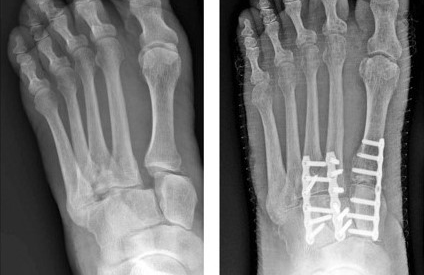
A Lisfranc injury refers to damage to the tarsometatarsal (TMT) joint complex — where the metatarsal bones meet the tarsal bones (mainly the cuneiforms and cuboid) in the midfoot. It can involve:
1. Ligament injury (Lisfranc ligament between the medial cuneiform and 2nd metatarsal base),
2. Fracture,
3. or a fracture–dislocation of the midfoot.
These injuries are serious but often missed, leading to chronic pain and deformity if untreated.
Causes:
1. Direct Causes:(a.) Crush injury: Heavy object falling on the foot.
(b.) Motor vehicle accidents: Foot trapped on pedal during impact.
2. Indirect Causes (more common):
Axial load on a plantarflexed (pointed-down) foot, e.g.:
- Twisting the foot while stepping down stairs or off a curb.
-Sports injuries (football, horseback riding, windsurfing).
-Falls from height.
-Essentially, a force that twists or compresses the midfoot while the forefoot is fixed can disrupt the Lisfranc joint.
Symptoms
- Midfoot pain and swelling, especially on the top of the foot.
- Pain worsens when standing or walking, especially pushing off the foot.
- Bruising on the sole of the foot (plantar ecchymosis) — a key diagnostic sign.
- Inability to bear weight on the affected foot.
- Visible deformity (if dislocation present).
- Tenderness over the tarsometatarsal joints on palpation.
(a.) Non-Surgical (Conservative):
Used for stable, non-displaced injuries (no gap between metatarsals).
-Immobilization: Cast or CAM (controlled ankle motion) boot for 6–8 weeks.
-Non-weight-bearing for 6 weeks → gradual return to weight-bearing.
-Follow-up X-rays to ensure no displacement develops.
-Physical therapy for range of motion and strengthening after immobilization.
(b.) Surgical Treatment:
Indicated for:
-Displaced fractures/dislocations.
-Instability (2 mm gap between 1st and 2nd metatarsals).
-Fracture–dislocations with midfoot collapse.
(c.) Procedures include:
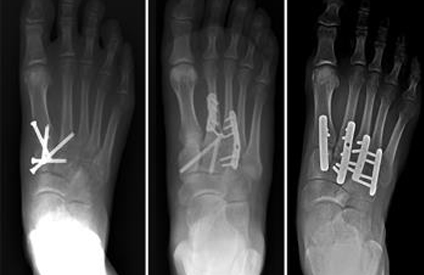
1. Open Reduction and Internal Fixation (ORIF):
-Screws or plates realign and stabilize the Lisfranc joint complex.
-Hardware usually removed after 3–6 months.
2. Primary Arthrodesis (fusion):
-Fuses affected joints, often for purely ligamentous injuries or severe damage.
-Provides long-term stability and reduces post-traumatic arthritis risk.

 Emergency No. : (+91) 74899-02258